
One-, two- and three-car garages
Garage Floor Epoxy in Melbourne, FL
A sealed garage floor that sheds oil, sand and stormwater and holds up to hot tires and the afternoon sun through the door.
- Free estimates at your property, with the concrete measured by us in person
- Moisture test on the concrete before any coating goes down
- Written quote that lists every prep step, coat and cost
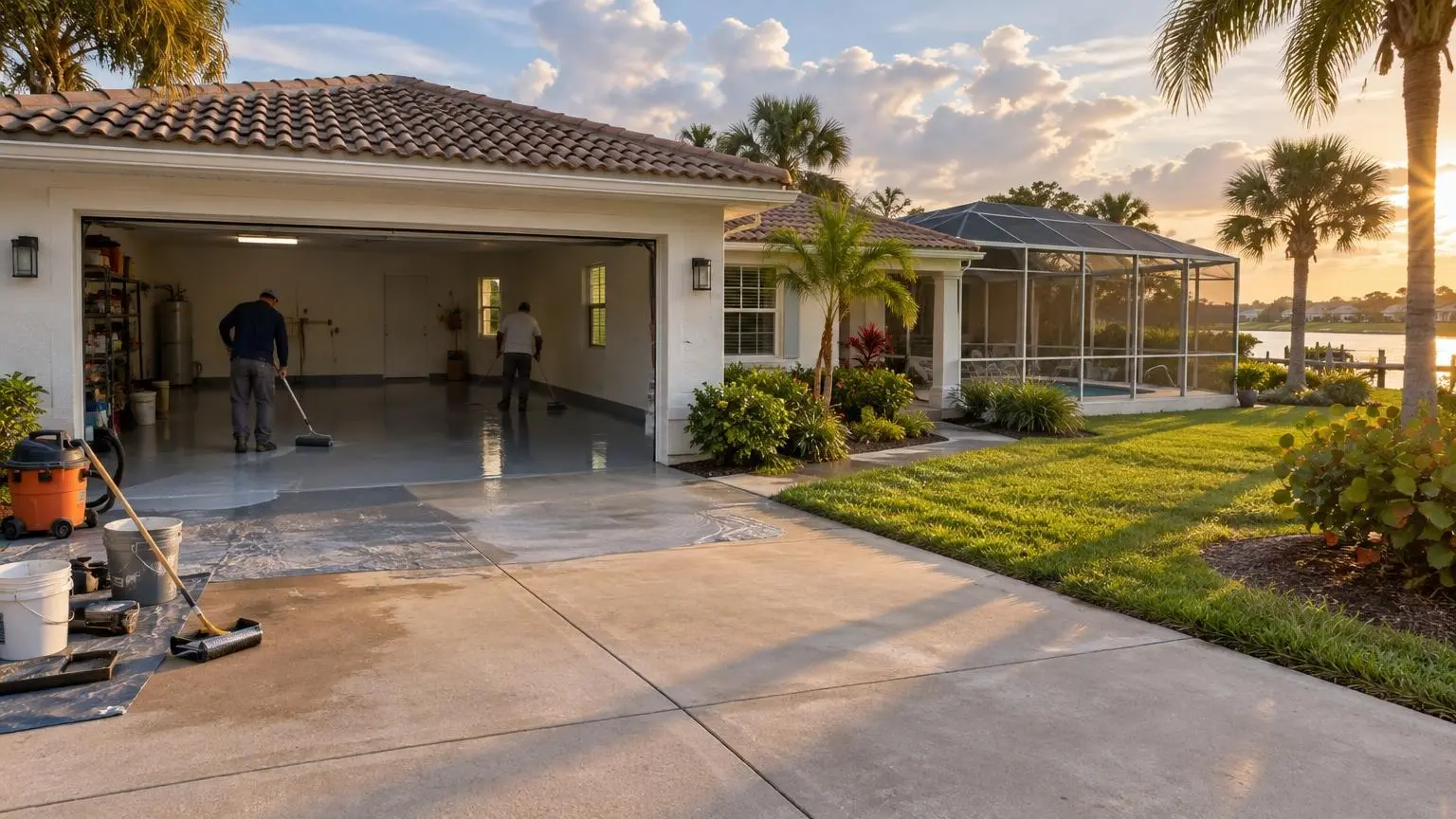
An Epoxy Garage Floor Built for Melbourne Garages
Garage floor epoxy in Melbourne, FL has a harder job than the same coating in a dry climate. The garage is where rain blows in under the door, where a wet car drips after a summer storm, where a boat trailer brings back salt and sand, and where the low afternoon sun bakes the first few feet of concrete. A good epoxy garage floor seals all of that out of the slab, cleans with a hose and a squeegee, and brightens a room most people walk through every day. A poor one peels at the tire lines within a couple of years. The difference is almost entirely in the testing and preparation, which is where we spend most of our time.
Why kit coatings fail in Brevard garages
Roll-on kits from the hardware store are a thin layer over concrete that has only been washed or acid etched. That surface is smooth and often still holds old oil, sealer or moisture. Add Florida heat, hot tires that soften the film, and moisture pushing up from below, and the coating lets go. HomeGuide puts DIY kits at $200 to $700, and we often grind off a kit that has failed before we can start. A professional garage floor coating is several times thicker, goes onto diamond-ground concrete and is built from a primer, a body coat and a topcoat chosen for the conditions in that garage.
Moisture and the slab underneath
Melbourne averages about 51 inches of rain a year, and a garage slab sits directly on the soil. Slabs from the 1950s and 1960s, which make up about a quarter of the city's homes, often went down without a vapor barrier, and even newer slabs can carry moisture after a long wet season. The concrete gets tested before we write a quote. If the numbers come back high, a moisture-tolerant epoxy primer goes down beneath the system. If they are beyond what any primer can handle, we tell you and explain what has to change first, such as drainage at the apron or more drying time.
Older garages versus newer ones
The median build year for Melbourne homes is 1985, according to city housing data, so many garages here have decades of history: paint layers, oil soaked into the concrete, a crack across the middle and chipped control joints. Those floors need a deeper grind, degreasing, crack filling and joint repair. Garages in newer builds, such as those in Viera, which broke ground in 1989, usually have a builder's curing sealer that resin will not stick to until it is ground off. We look for both at the estimate and itemize the prep on the quote, so the cost of each step is clear.
The sun at the door
Ordinary epoxy breaks down in UV light. In HomeGuide's ratings for UV resistance, epoxy scores poor to fair while polyaspartic scores excellent. In a west- or south-facing Melbourne garage, the strip of floor the sun reaches can yellow within a season under a pure epoxy topcoat. For that reason we finish garage floors with a clear polyaspartic topcoat over the epoxy base. You get epoxy's build and bond with a top layer that stays clear in light.
Finishes for how you use the garage
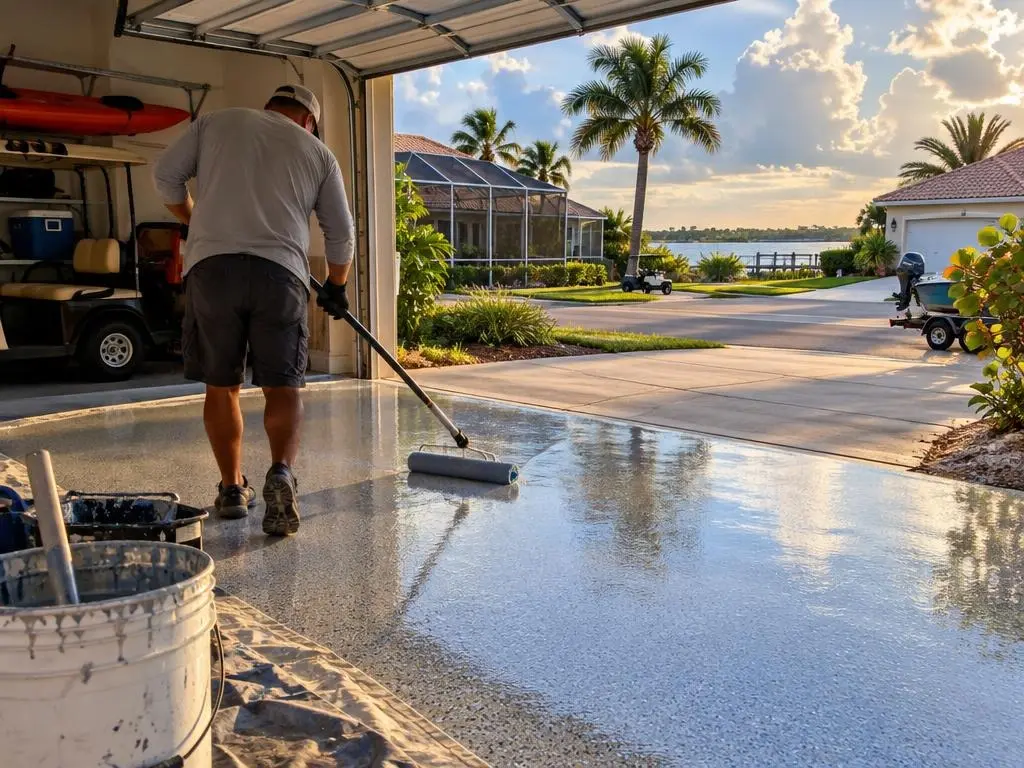
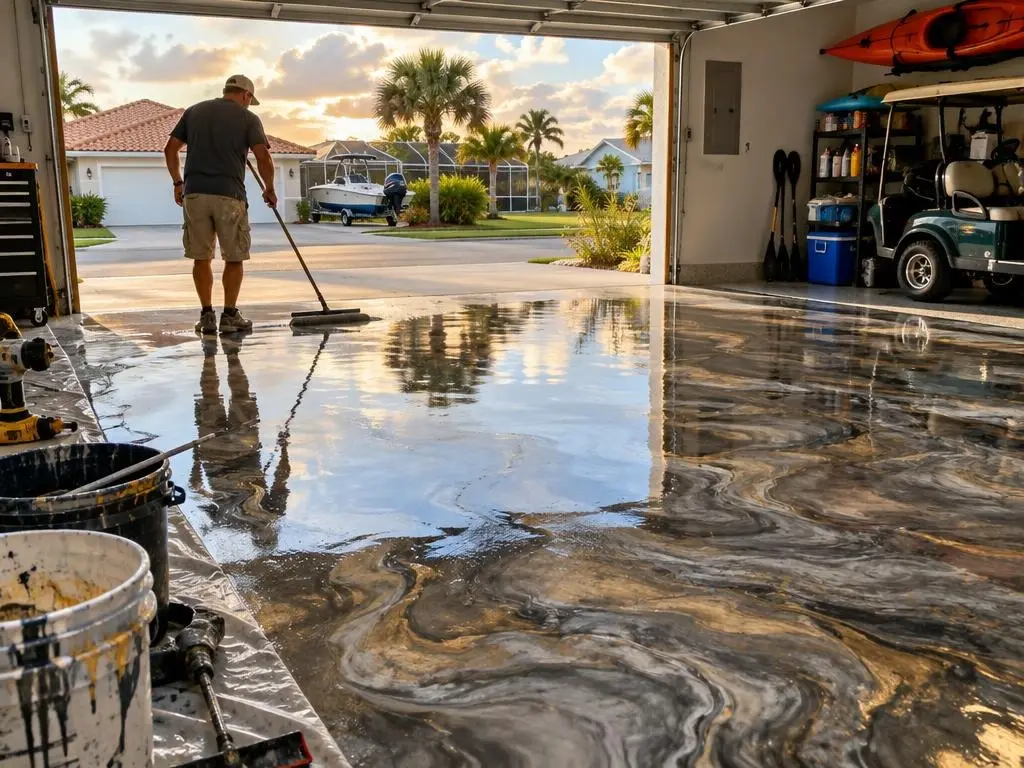
For a workshop or home gym, a single solid color with mild texture works well. A full broadcast of vinyl chip flake hides dust, sand and small stains, which matters when beach gear and fishing tackle come in and out. If you rinse a boat, a trailer or a golf cart inside, grit goes into the topcoat so the floor is not slippery when wet. We can also carry the coating up the short stem walls and onto the garage steps for a cleaner finished edge. Tell us what lives in the garage and we will suggest a system to match.
Winter, storms and the slab
Melbourne's climate is classed as humid subtropical, close to tropical, and Wikipedia notes the city averages about two days of frost a year, with an all-time record low of 19 degrees. That means freeze-thaw damage and road salt, the big problems for garage floors up north, are rare here. The stresses are different: long stretches of high humidity, a hot and wet season from late May through October, and tropical storms. Hurricane Erin set a city rainfall record of 9.06 inches in a day in 1995. A coated garage floor will not stop a storm surge, but it does shed rainwater that blows under the door, wipes clean after a storm and does not soak up the muddy water and debris that bare concrete holds onto. If your garage has taken on water in the past, tell us. We look closely at moisture readings and at how the apron and driveway drain before we pick a primer.
Getting the quote right
The garage is measured wall to wall, including any bump-outs or a golf cart bay. We note the door type and which way it faces, because that tells us how much sun the floor gets. We look for low spots where water sits, settlement cracks that have shifted, and stains that might need extra grinding. All of that shows up on the written quote, along with the system, the number of coats and the cure schedule, so nothing about the job is a surprise once we begin. Get a free estimate
Golf carts, boats and tools
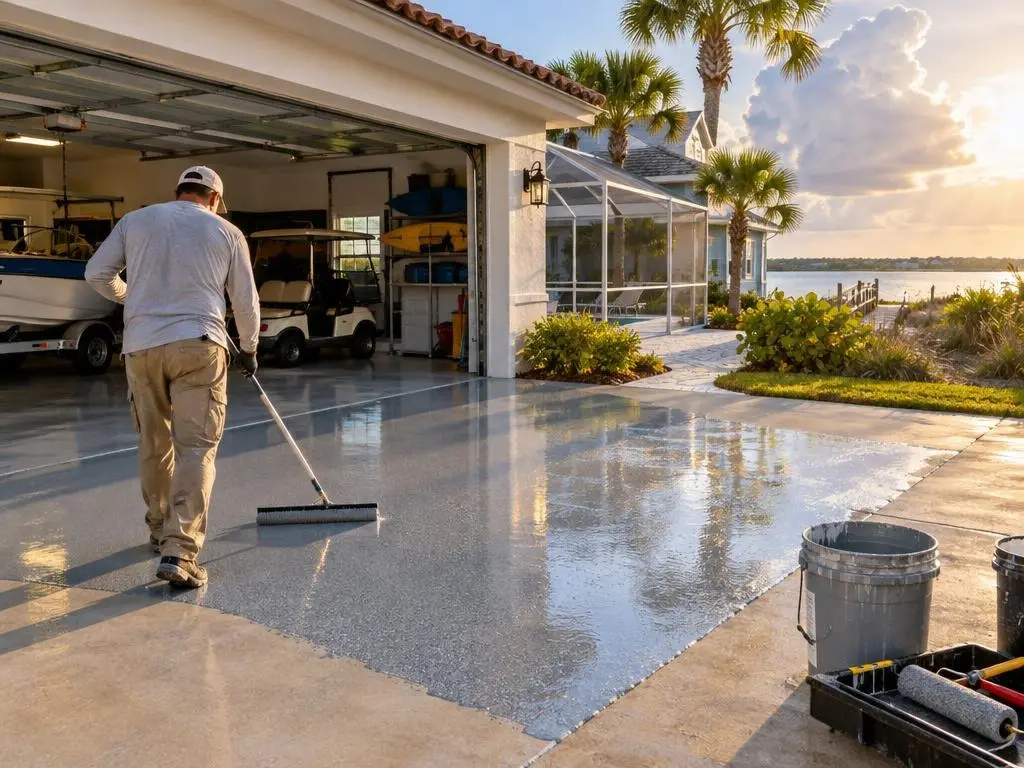
Garages in south Brevard often store a golf cart, a center-console boat on a trailer, kayaks and paddleboards, or a full woodworking or mechanic's bench. Trailer tongues, jack stands and rolling toolboxes put point loads on the floor, so a thicker build matters more than in a garage that only parks a sedan. We will ask what sits where and plan the system around it.
What a Garage Floor Coating Includes
Every garage floor coating we install runs across the entire slab, from the threshold under the door to the back wall.
Slab moisture test
A moisture reading taken before we quote, so we can match the primer and system to the slab.
Diamond grinding
Diamond grinding across the whole floor and its edges opens the concrete and strips sealers, paint and weak surface.
Old coating removal
Peeling kits, paint and failed epoxy ground off down to bare, sound concrete.
Crack and joint repair
Cracks, pits and chipped control joints are patched, then ground level before any coating.
Base, color and topcoat
An epoxy base, solid color or flake layer, and a clear UV-stable polyaspartic topcoat.
Stem walls and steps
Where you want it, the coating continues up the low concrete curb and onto the garage steps.
Typical Garage Floor Epoxy Costs
| Garage or item | Published range (source) |
|---|---|
| Installed epoxy, per sq ft | $4 to $10 (HomeGuide) |
| One-car garage, epoxy | $1,200 to $3,900 (HomeGuide) |
| Two-car garage, epoxy | $1,600 to $5,800 (HomeGuide) |
| Three-car garage, epoxy | $2,300 to $8,600 (HomeGuide) |
| Polyurea garage coating, per sq ft | $5 to $10 (HomeGuide garage floor coating guide) |
| Crack and chip patching | $25 to $250 (This Old House) |
| DIY kit, for comparison | $200 to $700 (HomeGuide) |
These are national published ranges, not a Melbourne quote. Garage size, slab condition, old coatings and your choice of finish all shift the total. After we measure and test your garage, the number written on your estimate is the price.
How a Garage Floor Job Runs
1. Visit and test
We take measurements, run a moisture test and note cracks, stains, old coatings and how you use the garage.
2. Written quote
You get the system, coats, prep, cure times and total in writing.
3. Grind and repair
We diamond grind the slab, vacuum and degrease it, then fill cracks and joints.
4. Coat
Primer and base, color or flake, then a UV-stable topcoat, applied when the slab is safely above the dew point.
5. Cure and hand back
You get clear times for foot traffic, reloading the garage and parking, based on the products we applied.
Why Choose Us for Garage Floor Epoxy
Prep is on the quote
Grinding, repairs and coating removal are listed, so nothing is hidden in a single number.
A topcoat that handles sun
Every garage gets a UV-stable finish, since most Melbourne garage doors stay open in daylight.
Weather-aware scheduling
We watch humidity and dew point and will move a day rather than coat a damp slab.
Garage Floor Epoxy Questions
How long does garage floor epoxy last?
HomeGuide puts thin water-based epoxy at 3 to 5 years and solid epoxy systems at 10 to 20 years. Prep, slab moisture and the topcoat are what decide where a floor lands in that range.
When can I park in the garage again?
Per HomeGuide, a car should stay off epoxy for 2 to 7 days; a polyaspartic topcoat shortens that wait. We confirm a firm time for your exact system.
Will hot tires lift the coating?
Thin coatings over poorly prepared concrete are where hot tire pickup usually shows up. A diamond-ground slab, a bonded epoxy base and a hard topcoat resist it.
Can you coat a garage with oil stains?
Usually. We degrease and grind, then check that oil has not soaked so deep that the coating will not bond. Badly soaked spots may need extra grinding or a patch.
Is the floor slippery when wet?
A smooth gloss finish can be. Grit mixed into the topcoat, or a flake broadcast, gives a wet floor better grip.
Garage Floor Epoxy Service Areas
- Epoxy Flooring in Melbourne, FL
- Epoxy Flooring in Palm Bay, FL
- Epoxy Flooring in West Melbourne, FL
- Epoxy Flooring in Satellite Beach, FL
- Epoxy Flooring in Indian Harbour Beach, FL
- Epoxy Flooring in Indialantic, FL
- Epoxy Flooring in Melbourne Beach, FL
- Epoxy Flooring in Viera, FL
- Epoxy Flooring in Rockledge, FL
- Epoxy Flooring in Cocoa, FL
- Epoxy Flooring in Cocoa Beach, FL
- Epoxy Flooring in Merritt Island, FL
- Epoxy Flooring in Titusville, FL
- Epoxy Flooring in Cape Canaveral, FL
- Epoxy Flooring in Malabar, FL
- Epoxy Flooring in Grant-Valkaria, FL
- Epoxy Flooring in Sebastian, FL
- Epoxy Flooring in Vero Beach, FL
- Epoxy Flooring in Suntree, FL
- Epoxy Flooring in Port St. John, FL
- Epoxy Flooring in Micco, FL
Get a Garage Floor Epoxy Estimate
Get your garage measured and tested, with a written quote, at no cost.